Google Ads Certification for CFD and Forex Brokers: 2026 Requirements

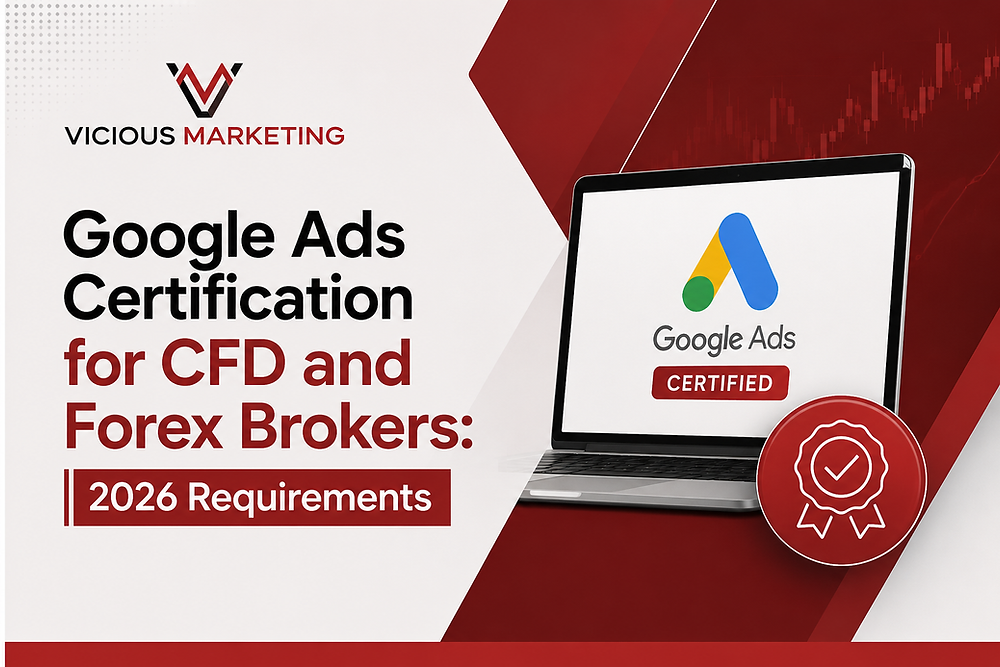
If you run paid search campaigns for a brokerage, then you understand that Google doesn't care about “leveraged trading” products the same way as the rest of its platform. Earning google ads certification for forex and CFD brokers isn't something you should take for granted, it's a serious filter that can mean your ads don't run. Part of this shift toward Google Ads in 2026 involves moving portions of the certification process into the Google Ads account interface, altering the way brokers, introducing brokers (IBs), and affiliates apply for certification.
This guide will provide you with an understanding of what the certification actually entails, who needs it, how to apply, why certifications are rejected, what your landing pages and your ad copy should contain, how long it takes to bind and what happens if you do not do so at all.
What Google Ads Certification Covers
Google groups CFDs and rolling spot forex under a category it calls "complex speculative financial products." This bucket includes contracts for difference, rolling spot forex (commonly just called "forex" or "FX" trading), financial spread betting, and other similar leveraged instruments. These products share a common trait: they let traders take on position sizes larger than the actual capital in their account, which is exactly why Google subjects them to its strictest review tier.
Binary options are treated separately and are banned outright, no certification path exists for them, regardless of how the product is packaged or marketed.
Once approved, CFD and forex ads are only allowed to serve as "Eligible (limited)," meaning Google still restricts where and when they appear even after certification. This is one of the core parts of review of any CFD advertising Google ads policy, certification doesn't grant unlimited access, it grants conditional access tied to jurisdiction, licensing scope, and ongoing policy compliance.
Who Needs to Get Certified
Certification isn't limited to the broker itself. Google's policy applies to anyone running ads that promote these products, which means:
- Brokers and trading platforms advertising their own CFD or forex offering directly.
- Introducing brokers (IBs) who run paid campaigns to refer clients to a partner broker.
- Affiliates and aggregators who publish comparison content, "best broker" rankings, or lead-generation pages that drive traffic toward CFD or forex sign-ups.
A common misconception is that affiliates are exempt because they don't hold the trading license themselves. They're not. The forex broker Google ads compliance requirements remain the same, whether your ad destination provides signals for trading these products, even indirectly or through a comparison site or review page. Each entity in the funnel needs its own certification for each location it targets.
Step-by-Step Application Process
The application process itself hasn't changed in substance, but where you submit it has. As of 2026, Google is rolling out in-account certification for select categories, including complex speculative financial products, moving applications out of the Help Center form and into the Google Ads interface itself. To apply from your account:
- Go to the Admin tab in the left-hand navigation.
- Open the Policy submenu, then select Account.
- Click Apply for certification if the option is available to your account (the rollout is gradual, so not every advertiser will see it immediately, if it's missing, continue through the Help Center).
Regardless of which pathway you use, you'll need to prepare documentation covering:
- Proof of licensing from the relevant regulator in each country you plan to target, for example, FCA authorization in the UK, CySEC or another national regulator's approval within the EU, ASIC licensing in Australia, or CFTC/NFA registration in the US.
- Registration numbers and business details matching the entity running the ads.
- A separate application per location, a license covering one jurisdiction does not extend to others, and Google requires a distinct submission for each country or country group you intend to target.
These are basic Google ads financial services certification requirements, and they apply on top of, not instead of, any local advertising laws in the markets you're entering.
Common Reasons Applications Get Rejected
Most rejections trace back to a handful of recurring issues:
- Licensing gaps: The submitted license does not clearly specify the product being advertised (e.g., a general investment advice license does not mean the license could be for leveraged CFD trading), and/or the submitted license does not cover the country being targeted.
- Landing page mismatches: The ad offers one product and the landing page offers a different product or broker entity or no disclosures at all.
- Missing or buried risk disclosures: Risk disclosures that appear on some page on the site but not on the page the ad is on.
- Incomplete business information: Discrepancies between the name of the business in the license and in the Google Ads account.
- Targeting outside approved markets: Google will not accept CFD and forex ads in countries that do not have regulatory regulations in place.
Landing Page and Ad Copy Requirements
Certification approval doesn't mean your work is done, every ad and landing page still needs to independently comply with policy on an ongoing basis. Expect the following to be scrutinized:
- Risk disclosures displayed prominently, not in footnotes. In the EU, for example, ads and landing pages typically need to state the percentage of retail investor accounts that lose money trading CFDs with that provider.
- Accurate leverage information that matches the caps allowed in the target jurisdiction, advertising leverage levels above the local regulatory limit is a fast way to get flagged.
- No unrealistic return claims. Phrases suggesting guaranteed profits, "risk-free" trading, or specific outsized returns are treated as red flags and will typically trigger disapproval.
- Geo-consistency between the ad's targeting, the landing page content, and the license on file, a page written for one region's regulatory framework can't be reused for another without updates.
- Functional, transparent destinations, working links to account terms, fee structures, and any KYC/AML disclosures relevant to onboarding.
Timeline and Renewal Requirements
Once submitted, straightforward ad disapprovals tied to fixable policy issues are often resolved within 24–72 hours after a correction and automatic re-review. Full certification applications, and especially first-time submissions with regulatory documentation, generally take longer to process, and timelines can extend further when multiple jurisdictions are involved.
Certification isn't a one-time event. If your business expands into a new market, you need to secure the local regulatory license first, then submit a new certification application specifically for that market, an existing approval elsewhere doesn't transfer automatically. Google also expects ongoing accuracy: if your licensing status, target markets, or product structure changes, your certification and supporting documentation need to be updated accordingly.
Risks of Running Ads Without Certification
Running CFD or forex ads without the required approval isn't a minor technicality, it puts your entire account at risk. Google generally issues a warning at least seven days before suspending an account for financial services policy violations, but repeated or serious violations can still escalate quickly to policy strikes and eventual account suspension.
Beyond the immediate loss of ad delivery, unresolved violations can affect your ability to run any campaigns on the account going forward, not just the ones tied to CFD or forex products.
For brokers and affiliates relying on paid search for client acquisition, an account-level suspension can mean an abrupt and costly gap in lead flow while you go through the appeals process.
Frequently Asked Questions
Q1. Do I need Google Ads certification to advertise forex trading?
Yes. Rolling spot forex falls under Google's complex speculative financial products policy, and ads promoting it require certification in each market you target, in addition to holding a valid license from the relevant financial regulator.
Q2. How long does Google Ads financial services certification take?
Simple ad disapprovals that are corrected and resubmitted are often reviewed within 24–48 hours. Full certification applications with regulatory documentation typically take longer, particularly when multiple countries or complex licensing structures are involved.
Q3. What documents are required for CFD advertising certification?
You will need to have proof of licensing from the relevant regulator (FCA, CySEC, ASIC, CFTC/NFA as applicable, depending on your jurisdiction), matching business registration information and a separate application for each location you wish to target.
Q4. Can affiliates advertise CFD products on Google without certification?
No. Affiliates, IBs, and aggregators driving traffic toward CFD or forex sign-ups are held to the same certification requirements as the broker itself, since Google's policy applies to any ad destination that provides signals for trading these products.
Q5. What happens if my Google Ads account runs CFD ads without certification?
Uncertified ads will typically be disapproved, and continued or repeated violations can lead to a policy warning followed by account suspension. Google generally provides at least seven days' notice before suspending an account for this category of violation, giving advertisers a window to correct the issue.