The Full-Funnel Strategy That Scaled a DTC Brand from $20K to $1M Without Hiring a Single SDR

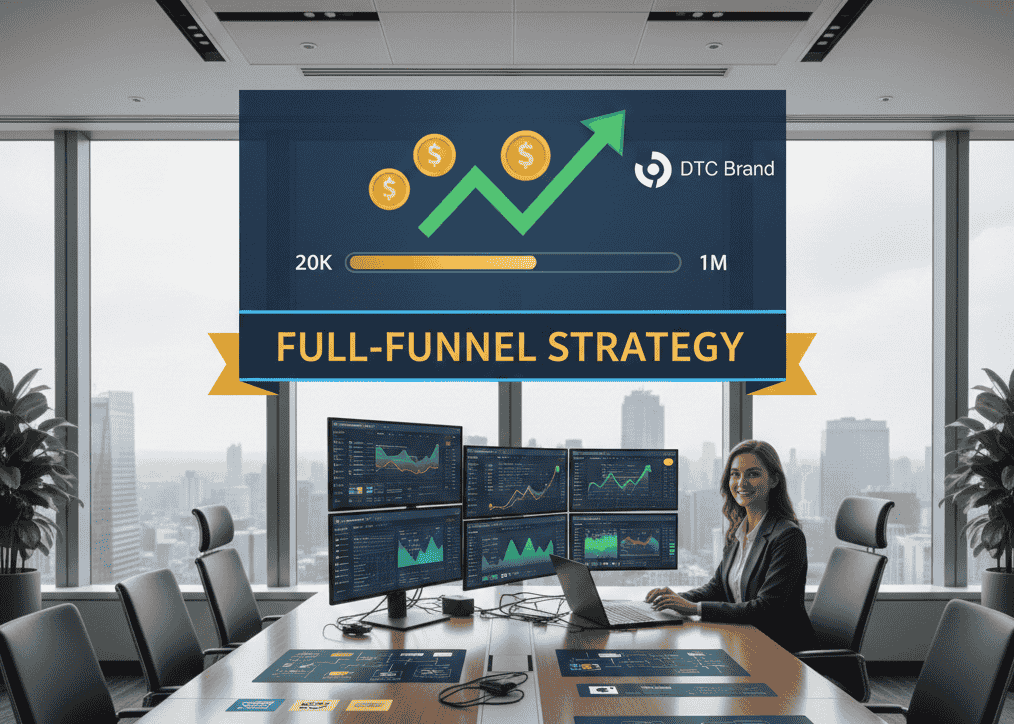
One DTC brand managed to achieve remarkable success without hiring any outbound sales team members by creating and executing a full funnel marketing strategy that scaled from $20,000 in monthly revenue to over $1 million in annual revenue without ever hiring an SDR (Sales Development Representative).
This story goes beyond paid ads or social media hacks – it shows how an effective, measurable, customer-focused full funnel marketing strategy can transform an unassuming startup into a booming brand. Here, we’ll examine exactly how they did it step-by-step so you can apply this blueprint yourself.
What Is a Full Funnel Marketing Strategy?
A full funnel marketing strategy encompasses every stage of customer journey–from first touch through repeat purchase. It coordinates marketing activities at every step in the funnel: first contact, initial purchase and repeat purchases.
-
Top of Funnel (TOFU): Create awareness and build audience support
-
Middle of Funnel (MOFU): Engagement and education
-
Bottom of Funnel (BOFU): Conversion and sales activities
-
Post Purchase: Retention and Referrals
This approach’s strength lies in its ability to meet potential buyers where they are: mentally, emotionally and behaviorally.
Simply stated, full funnel marketing strategies ensure no lead is missed and no customer forgotten after making their purchase.
How a Full Funnel Marketing Strategy Generated $1M Without SDRs
Let’s look at how one DTC brand used a full funnel marketing strategy to generate $1 Million without resorting to cold calls, email blasts, or outbound sales reps.
1. Top of Funnel: Building Awareness & Trust
The initial phase in their full funnel marketing strategy focused on audience growth. Instead of throwing money at unstructured ads, the brand focused on:
-
Target top-of-funnel search queries with educational blog content aimed at targeting them.
-
Organic social posts with an established brand identity
-
Collaborations of influencers for credibility and reach.
They invested heavily in SEO and storytelling to ensure their brand was visible where its target customers congregated – well before anyone even considered buying.
TOFU’s cost-effective and sustainable marketing approach enabled their full funnel strategy. Each piece of TOFU content served two roles simultaneously – drawing attention and subtly qualifying leads.
2. Middle of Funnel: Nurturing and Educating Prospects
Next came nurturing: an essential element of any full funnel marketing strategy is what happens once someone clicks or follows your link.
Here is what they deployed:
-
Email sequences tailored to visitor interest can also be sent automatically.
-
Retargeting ads relevant to content consumed.
-
Webinars and video explainers that showcase product benefits are also available for viewing online.
-
Customer Reviews and Case Studies Shared across Touchpoints
Even without SDRs directly qualifying leads, their conversion rate is much above industry benchmarks thanks to mid-funnel education, which was crucial in raising product knowledge and trustworthiness for their target customer group.
This business swiftly transformed browsers into believers by segmenting their lists, automating follow-ups, and providing content that matched buyer intent. Sales felt less like an impersonal pitch and more like an interesting conversation thanks to their whole funnel marketing approach.
3. Bottom of Funnel: Closing Without Pushback
To successfully close their sales cycle without hard-selling tactics, their full funnel marketing strategy included creating an e-commerce experience with high conversion rates. At this stage, their full funnel marketing plan consisted of:
-
Exclusive limited-time offers based on user behavior are now available.
-
Cart abandonment emails highlighting urgency and testimonials will also be sent.
-
Live chat support to address last-minute objections
-
Exit-intent popups with micro-discounts for fence-sitters.
All of this was accomplished via marketing automation and intelligent design–without needing SDRs to facilitate.
Cart abandonment is at the center of DTC ecommerce challenges. The global average for cart abandonment is 70.19%, or about seven out of ten customers who have placed items in their shopping carts have abandoned those items without making a purchase. The rate is even higher for mobile devices, at about 84%.
The good news is that the average large ecommerce site can increase their conversion rates by 35.26% simply by improving their checkout process, based on checkout usability research by Baymard Institute. No discounts are needed. Abandoned cart emails are also an important conversion opportunity. The average abandoned cart email has a 45% open rate, 21% click-through rate, and 10% conversion rate.
A three-email abandoned cart sequence can recover 37% more carts than sending one single email. Personalized abandoned cart emails can convert 2.5 times better than non-personalized emails. The most common reason for cart abandonment is not price. The top reasons for cart abandonment are unexpected additional costs (55%), forced account creation (18%), and a complicated checkout process (22%).
The top three levers for any DTC brand to improve their checkout process without offering any discounts are to remove one unnecessary form field, to enable guest checkout, and to display all fees before the final step.
Even here, the full funnel marketing strategy avoided hard selling by reducing friction and making buying seem effortless.
4. Post-Purchase Retention and Repeat Revenue
One of the most often ignored aspects of any full funnel marketing strategy is what occurs after purchase.
This direct-to-consumer (DTC) brand didn’t make that mistake, opting for post purchase marketing that included:
-
Onboarding emails containing product care tips.
-
Loyalty programs recognizing repeat buyers.
-
Referring customers who become advocates is the key to building customer loyalty and making customers advocates.
-
Feedback loops provide an effective method of gathering product reviews and insights.
The post-purchase period is where DTC economics actually come into play. An analysis that tracked 162,112 customers across 13 different DTC companies over a period of approximately 720 days revealed that a mere 21.2% of first-time customers return for a second purchase, a larger decline than any other stage in the customer lifecycle. However, this tiny percentage of 21.2% that manage to return for a second purchase account for a substantial 48.9% of total revenue.
Moving from a second purchase to a third purchase, the number jumps to 38.8%, and from a third purchase to a fourth purchase, it jumps further to 50.9%. In other words, the whole rationale for post-purchase investment is centered on acquiring that second purchase. Once that second purchase is acquired, the customer is statistically more likely to become a long-term customer.
In the world of ecommerce, the average repeat purchase rate for all ecommerce companies stands at 28.2% based on Shopify’s commerce data. A good CLV/CAC ratio for DTC companies is a bare minimum of 3:1. In other words, for every dollar spent on acquiring a customer, a company needs to be able to generate three dollars in gross profit from that customer over their lifetime.
Loyalty programs help companies achieve this ratio by a wide margin. A staggering 83% of loyalty programs have a positive ROI, averaging 5.2x. Members are 12-18% higher than non-members in terms of spend and have a higher CLV during the first year.
Lessons from the Frontlines
Here are three takeaways from this brand’s journey that you can apply to your own full funnel marketing strategy:
1. Offer Value – Each piece of content should provide some kind of benefit for readers; giving first helps build trust that eventually converts.
2. Automate Smartly Use automation intelligently – use it to guide, not nag. Behavior-triggered flows outperformed generic blasts by 2.5x.
3. Design is Essential – Conversion optimization was built into every stage of our funnel process from mobile UX design to CTA placement – design provided support at every point along the path to conversion.
4. Understand Your Metrics – A true full funnel marketing strategy must always be driven by data. Following instinct can be fun, but numbers keep us honest!
5. Make Your Customer Experience Part of Your SDR From websites and content creation, packaging design, and phone support – every touchpoint that interacts with your brand serves as part of your sales team. Make every touchpoint an integral component of achieving success for you and your company.
The DTC Benchmarks Behind This $1M Blueprint – What “Good” Actually Looks Like by Funnel Stage
Here’s a general idea of what the numbers for an average performance in the ecommerce world might look like, along with a hint at what exceptional execution might do differently.
-
The current conversion rate for the world at large in terms of ecommerce is 1.9-2%.
-
The average conversion rate for a Shopify store is a bit higher at 2.5-3%.
-
Mobile conversions are a bit lower than desktop conversions at 1.8% compared to 3.9%.
-
The average cart abandonment rate is at 70.19%.
-
The average cart recovery email has an open rate of 45%, and a conversion rate of 10%.
-
The average retention rate for an ecommerce store is 31%.
-
The conversion rate from first purchase to second purchase is 21.2%, and from second purchase to third purchase is 38.8%.
-
The CLV to CAC target is 3:1.
-
It costs 5-25 times more to acquire a new customer than to retain an existing one.
This gives an idea of what a brand might look like in terms of performance at average execution.
Final Thoughts: The Funnel Is the Future
One important lesson to be learned from this case study’s discussions about complete funnel marketing strategy is that huge growth doesn’t require an army. Your brand can effortlessly and naturally draw in, convert, and keep consumers if you have the proper whole funnel plan in place.
Although success won’t come right away, you may build an exponential customer funnel that compounds with perseverance, ingenuity, and customer-first strategies.
Start mapping and bridging holes throughout your customer journey, synchronizing content, advertisements, and automated processes, and creating your own complete funnel marketing strategy that will work for you around-the-clock as soon as your budget permits.
FAQs-
Yes, It takes an omni-channel approach, from awareness to loyalty – rather than solely on acquisition or one-off campaigns.
According to Baymard Institute’s 2025 benchmark, which is based on data from 50 separate studies, the average conversion rate worldwide is 70.19%. On mobile devices, this figure increases to 84%. The study also found that a normal large e-commerce site could increase its conversion rate by approximately 35.26% simply by improving its checkout process design.
A healthy CLV/CAC ratio for DTC brands is a minimum of 3:1; that is, for every dollar spent on acquiring a customer, a brand must make a minimum of three dollars in gross profit from that customer over their lifetime. It can cost 5-25 times as much to acquire a customer as it does to retain one. A mere 5% improvement in retention can increase profits by 25-95%.
Q3: What percentage of DTC customers actually make a second purchase?
Only 21.2% of first-time DTC buyers make a second purchase, according to an analysis of 162,112 customers across 13 brands. That 21.2%, however, generates 48.9% of all revenue. After the second purchase, conversion to a third accelerates to 38.8%, making the second purchase the single most important conversion event in the DTC customer lifecycle.
Overly focusing on just one area of their funnel. A great full funnel marketing plan takes into account education, engagement and sales strategies simultaneously.
Cart Abandon Recovery Emails far surpass regular ecommerce messages. On average, cart abandon recovery messages have a 45% open rate, a 21% click rate, and a 10% conversion rate for recovered carts. A series of three cart recovery messages results in approximately 37% more recovered carts than a single message. Personalized cart recovery messages have 2.5 times the effectiveness of regular cart recovery messages.
The average repeat customer rate across ecommerce is 28.2%, per Shopify commerce data. Industry experts consider 20–40% a healthy range depending on vertical. Subscription-based DTC models achieve 60–85% retention versus 20–35% for traditional transactional retail. Loyalty programme members spend 12–18% more than non-members and deliver measurably higher lifetime value within the first 12 months.