Enterprise SEO vs Traditional SEO: Which One Fits Your Brand

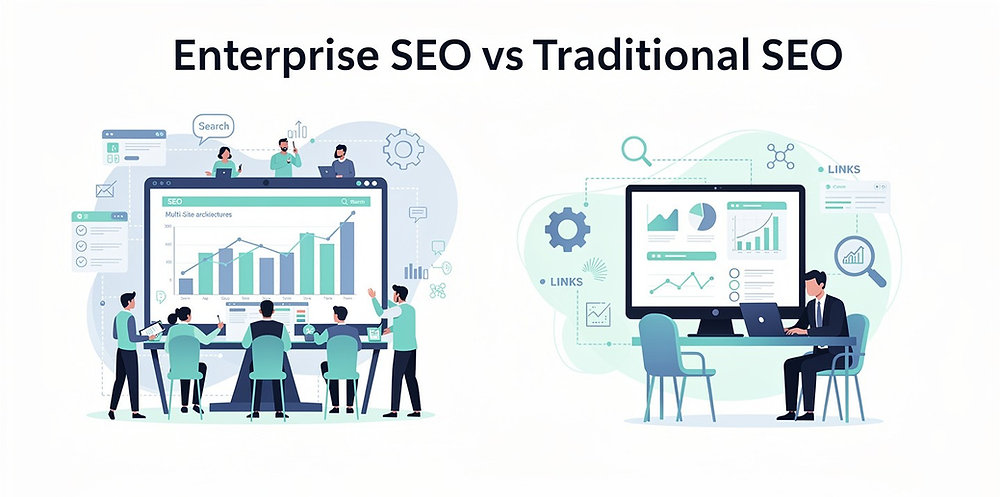
Moving from organic search results in the hundreds to hundreds of thousands of pages-or doing SEO across multiple brands, regions, and platforms-requires a completely different level of mindset than traditional SEO. At Vicious Marketing, we assist organizations through the space between enterprise SEO and traditional SEO, in identifying when complexity exceeds the reach of a specific toolset, as well as building systems to facilitate organic growth without overwhelming teams with a knot of tasks to implement.
This guide will discuss enterprise SEO vs small business SEO in terms of scope, number of people involved, tools needed, level of technical sophistication, etc., so that readers can determine whether their organization requires an enterprise approach to SEO or if the traditional methods are sufficient for their needs.
Enterprise SEO vs Traditional SEO: At a Glance
Traditional SEO definition suggests focusing on-site optimization of a limited number of web pages through manual keyword research, content creation, building links, and technical SEO, usually done by small teams or individuals with the help of various online tools such as Google Console, Ahrefs, and WordPress plugins.
Enterprise SEO operates at the scale of thousands, if not millions, of URLs, numerous domains, and markets across the globe, as well as complicated technical setups. It needs automation, a significant level of governance and collaboration, as well as integration at the platform level in order to maintain organic visibility without bottlenecks in manual work processes.
The core difference: enterprise SEO is about systems and automation; traditional SEO is about execution and expertise.
How Scale and Scope Differ Between Enterprise and Traditional SEO

When you think of enterprise SEO vs local SEO or the old way of doing things with the small site playbook, "scale" isn't just more of the same thing; it's a completely different world.
Crawl capacity and indexable URLs: For business sites, crawl budgets need to accommodate the millions of potential URLs generated by faceted navigation, filtering results, pagination, and user-generated content. Addressing crawl budgets, avoiding index bloat, and ensuring that Google correctly rewards valuable content are key objectives rather than secondary concerns.
Multi-domain and multi-regional complexity: Large businesses are often hosted across a variety of ccTLDs, subdomains, or subdirectories, and each one requires hreflang coordination, content strategies, and technical configurations that are region-specific and/or language-specific.
Template-driven content at scale: Instead of tuning individual pages, enterprises seek to optimize templates. A wrong title tag on one product detail page can touch 50,000 wrong URL title tags at once.
Content velocity: Companies can produce or modify hundreds of pages every day using automated feeds, CMS workflows, and product catalogs. Human processes can't keep up with the manual review and publishing model.
Technical architecture layers: Enterprise stacks include CDNs, microservices, headless CMS systems, API-driven rendering, and edge logic-a layer of complexity that small-site SEOs usually don’t have to consider.
Team Structure: How Enterprise SEO Teams Operate Differently
The organizational structure behind enterprise SEO vs traditional SEO creates fundamentally different workflows and challenges.
Traditional SEO Teams: Typically 1–5 people wearing multiple hats like strategy, content, tech, and link building all at the same time. Things can move quickly, and changes can roll out the same day or week.
Enterprise SEO Teams: Larger, more matrix-oriented organizations have a much more specialized structure: SEO strategists, technical SEO engineers, content operations managers, analytical experts, and developer liaisons, with recommendations moving through product managers, engineering sprints, and legal evaluations.
Governance and change Control: For enterprises, there are established processes that include documented processes, sign-offs with stakeholders, RACI charts defining Responsible, Accountable, Consulted, and Informed parties, and change request management systems. Even small changes, such as robots.txt updates that may take merely minutes on smaller sites, can easily translate into three meetings and a two-week release cycle on larger sites.
Developer and SRE Coordination: Typically, the SEO team for an enterprise solution does not have direct access to production environments. Instead, they define their needs, log Jira tickets, participate in sprint planning activities, and collaborate with SRE teams/DevOps teams in order to deploy changes without breaking any uptime SLAs.
Cross-functional Handoffs: SEO aligns with merchandising, paid marketing, products, legal/compliance, brand, internationalization, and customer support teams, and each has its own set of goals and measures.
Enterprise SEO Platform vs Traditional SEO Tools: What Changes
The difference between enterprise SEO tools and automation versus traditional point solutions reflects the operational gap.
Traditional SEO Tools: Ahrefs, SEMrush, Screaming Frog’s desktop crawler, Google’s Search Console, and plugins like Rank Math. Good for a one-off task, but they don't play well with large volumes of data, cannot be used for driving automated workflows through the API, and fail when you try to manage millions of URLs.
Enterprise SEO Platforms: Botify, Conductor, seoClarity, Oncrawl, and DeepCrawl (now Lumar). They provide log file analysis, server-side rendering analysis, and API-based reporting with automated report delivery via Jira or Asana integration. They also provide real-time crawl monitoring, data warehouse integration for ingesting petabyte-scale search and analytics data, and an end-to-end solution.
Automated Recommendations and Anomaly Detection: These tools allow the automatic identification of any canonical issues associated with a webpage, any indexation issues that might be affecting a particular webpage, and any regression related to Core Web Vitals.
Data Freshness and Velocity: Traditional tools might refresh ranking weekly, the Enterprise Platform queries Google APIs on an hourly cycle, ingests log files daily, and even enables real-time signals if Google’s crawl patterns change or organic traffic unexpectedly decreases.
Workflow Integrations: Enterprise platforms push tasks directly into engineering backlogs, trigger Slack messages, push data into dashboards to run executive reporting, and even output to business intelligence tools like Tableau or Looker, no more tedious bouncing around between spreadsheets.
Technical SEO Challenges That Only Appear at Enterprise Scale
SEO at scale vs manual SEO surfaces technical complexities rarely encountered in traditional engagements.
Site Migrations and Replat Forming: Migrating 100 pages is a weekend project; while migrating 500,000 pages across three domains, re-ranking them in a new tech stack, managing 301s, and executing a DNS cutover is a six-month SEO project with millions of revenue at stake.
Canonicalization Patterns: Enterprises generate a variety of URLs due to sort order, filters, session IDs, and tracking parameters, which can become exponential in nature. A solid approach to canonicals, along with proper handling of parameters in Search Console and server-side canonicalization, is a non-negotiable requirement.
Faceted Navigation and Filter SEO: Allowing every combination of filters to index would result in millions of thin, redundant pages, while disallowing all filters would destroy important long-tail landing pages. Crawl directives, matrices, and properly tuned crawl budgets can play significant roles for large SEO teams.
Pagination and Infinite Scroll: Traditional SEO might slap a rel="next/prev" to a 10-page blog archive; SEO teams at enterprises develop strategies for pagination on their product catalogue with thousands of pages.
Hreflang and Multi-regional Coordination: Coordinating hreflang across 15 languages and 30 country variants, with rules for fallbacks, canonicalization, and gaps, necessitates an automated process of validation, constant monitoring, and rigid governance to ensure cross-market cannibalization is nil.
JavaScript Rendering and Core Web Vitals at Scale: Enterprises often rely on client-side frameworks like React, Vue, and Angular, which can hinder rendering for a search engine. Troubleshooting rendering issues, setting up dynamic rendering or SSR, and managing Core Web Vitals for thousands of templates requires highly technical expertise.
How Enterprise SEO Handles Content Strategy at Scale
Enterprise SEO strategy treats content as a scalable system, not a series of one-off articles.
Content templates and dynamic pages: Instead of writing single product descriptions, large teams create templates that auto-populate details from PIMs or databases into thousands of unique SEO-friendly pages, all without lifting a finger.
Programmatic and Data-driven Content: Enterprises create location pages, comparison pages, or resource hubs from structured data directly, for instance, creating 10,000 city-specific service pages out of a single template and location database.
Content Governance and Approval Workflows: In multi-brand setups, editorial standards, legal disclaimers, and brand voice are controlled with approval workflows in the CMS itself, automated compliance checks, and stringent version control.
Content Pruning and Prioritization: Where traditional SEO would have manually audited hundreds of blog posts, enterprises rely on analytics, crawl data, and machine-learning signals to bring tens of thousands of low-value pages to the surface, identify redirect consolidation candidates, or flag noindex targets at scale.
Topical Authority at Scale: Instead of chasing isolated keywords, enterprise content plans map full taxonomies, build hub-and-spoke structures across product categories, and expand topical coverage with template-driven content systems that align to search demand.
How Enterprise SEO Measures ROI and Attribution Differently

How enterprise teams measure SEO success differently from smaller teams reflects data sophistication and statistical rigor.
KPI Design for Complexity: Traditional SEO tracks rankings, organic sessions, and conversions; In large companies, additional dimensions such as crawl efficiency (what percentage crawled versus indexed), performance per template in conversion volume, international traffic share, and marketing budgets allocated to organic traffic are added.
Statistically valid testing: With high traffic volumes, enterprise SEO teams can conduct experiments on a large scale by tweaking title tags for 10,000 pages and comparing results using statistical significance. For smaller sites, there is just not enough traffic to run A/B tests.
Attribution Across Channels: In many cases where enterprises use multi-touch attribution, model structures will include organic’s incremental contribution, effectively separating SEO’s contribution from paid, email, social, and direct channels.
Forecasting and Scenario Modelling: Enterprise stakeholders are also interested in guided forecasts. In most cases, an SEO team develops models that predict changes in traffic or revenue due to migration strategies, altering templates, or investing in content.
Executive reporting and OKRs: Traditional SEO reports to marketing managers; enterprise SEO reports to C-suite and various boards in direct alignment with company-level OKRs and quarterly guidance.
When to Use Enterprise SEO vs Traditional SEO: Decision Checklist
Not every business needs enterprise-grade infrastructure. Use this decision checklist to evaluate if you've crossed the threshold:
Choose traditional SEO if:
- You manage fewer than 5,000 indexable pages
- One or two people handle all SEO work
- Changes ship within days, not sprints
- You operate in a single country/language
- Tools like Screaming Frog and Ahrefs meet your needs
- Revenue risk from organic traffic is under six figures annually
Choose enterprise SEO if:
- You manage 10,000+ pages (or expect to soon)
- SEO intersects with 5+ internal teams or departments
- Changes require developer sprints and release coordination
- You operate across multiple domains, brands, or international markets
- Manual workflows create bottlenecks and regression risks
- Organic contributes seven- or eight-figure revenue annually
- You need API integrations, log-file analysis, or automated monitoring
- Compliance, governance, and audit trails are mandatory
Enterprise SEO Implementation Roadmap: Pilot, Scale, and Govern
Transitioning from traditional to enterprise SEO doesn't happen overnight. We recommend a phased approach:
Phase 1: 90-Day Pilot (Proof of Concept)
- Select one high-impact use case (e.g., product-page templates, international hreflang fixes)
- Deploy enterprise tooling on the pilot segment
- Document workflow changes, stakeholder roles (RACI), and success metrics
- Measure uplift and build an internal case for broader rollout
Phase 2: Scale (Months 4–9)
- Expand pilot wins to additional templates, markets, or domains
- Formalize governance: change-request processes, approval chains, documentation standards
- Train cross-functional teams on SEO requirements and handoff protocols
- Integrate enterprise SEO platforms into existing BI, analytics, and project-management stacks
Phase 3: Govern (Ongoing)
- Establish performance monitoring dashboards and automated alerting
- Conduct quarterly audits to catch technical debt and regression
- Continuously optimize templates, canonicalization rules, and content workflows
- Evolve governance as organizational complexity grows
How to Evaluate and Choose an Enterprise SEO Platform
Enterprise SEO Platform pricing typically ranges from $20,000 to $500,000+ annually, depending on URL count, feature sets, and support SLAs. When evaluating vendors:
Pricing Transparency: Understand what drives cost, crawled URLs, API requests, user seats, or module add-ons. Think about locking multi-year terms to avoid any renewal surprises.
Support and SLAs: Enterprise contracts should guarantee response time, a designated customer success manager, and good training and onboarding support should be a given. Test response times during trial periods.
Integration Requirements: Make sure that APIs, data export options, and webhook infrastructure are available for your own BI tools, CMS systems, analytics systems, and project management tools. Pre-built connectors will also help save engineering hours.
Data Ownership and Export: Verify that your data can be exported if you switch vendors, and prevent lock-in situations where vendors profit from holding exclusive data insights.
Trial success Criteria: Well-defined goals for the proof of concept phases need to be established, such as discovering 10 high-impact technical issues currently not addressed by existing tools or automating a monthly report currently taking 20 hours.
Top Enterprise SEO Mistakes and How to Avoid Them
Even sophisticated organizations stumble during enterprise SEO transformations. Avoid these traps:
Ignoring Governance: If documentation and approvals are stripped out, there can be rogue changes that break indexation or destroy rankings. Mitigation: Formalize change control from day one.
Poor Change Control: Updates for shipping SEO fixes, along with other unrelated code, pose a rollback threat. Mitigation: Ensure SEO updates are shipped separately with their rollback plans.
Under-estimating Technical Debt: Legacy canonicals, stale redirects, and orphaned pages often accumulate over time. Mitigation: Budget quarterly debt-reduction sprints.
Siloed teams: Typically, SEO, product, engineering, and content tend to operate in siloes, creating conflicting interests or goals. Mitigation: Embed SEO stakeholders in cross-functional pods and sprint planning.
Over-reliance on Automation: Tools detect the problems; however, judgment is required to determine the fixes of interest and understand the anomalies. Mitigation: Maintain experienced SEO practitioners who understand the "why," not just the "what."
Frequently Asked Questions
Q1. What is the difference between enterprise SEO and traditional SEO?
Enterprise SEO operates at scale with thousands to millions of pages, with a plethora of markets and complex technology stacks. It requires a high level of automation for enterprise SEO challenges and governance, and collaboration with developers. On the other hand, traditional SEO relates to smaller sites with hands-on optimization being executed in compact teams with specialized tools.
Q2. At what scale should a company move from traditional SEO practices to an enterprise approach?
This signal or indicator often appears around the 10,000 pages, several domains or markets, or where the effort required by SEO necessitates sprints and releases. Where the workflow gets bogged down or where organic traffic is driving seven figures in revenue, it's time to evaluate enterprise SEO use cases and tooling.
Q3. Which tools become necessary once you cross the enterprise threshold?
You will also see log file analysis tools (Botify, Oncrawl), enterprise crawlers with API-level controls (seoClarity, Lumar), reporting and alert tools, workflow integration with tools like Jira/Asana, and integration with most common business intel tools for executive-level reporting.
Q4. How do enterprise teams measure SEO success differently than smaller teams?
In larger organizations, the focus moves to template-based performance, statistically valid A/B testing, multi-touch attribution modeling, forecasting and scenario planning, and tying SEO results to company OKRs.
Q5. How long does an enterprise SEO implementation usually take?
A pilot program runs for 90 days. Then, a full-rollout process can take anywhere between 6 and 12 months, all dependent on the intricacy of the organization, the level of technical debt, and the alignment of the stakeholders. It's also important to note that optimization and maturity levels are never static, as enterprise SEO is not really a finish line.
Q6. Can small businesses use enterprise SEO tactics? Will that help or waste resources?
Conserve small businesses on things like template optimization, automation, and even governance structures. Too many enterprise structures and toolsets can over-accessorize simple needs, however. Invest in enterprise tactics when complexity justifies overhead-premature enterprise adoption wastes budget on tools and workflows that exceed operational capacity. Focus on traditional SEO excellence first, then scale systems as growth demands.