Fintech Performance: Lowering CPL in High-CAC Environments

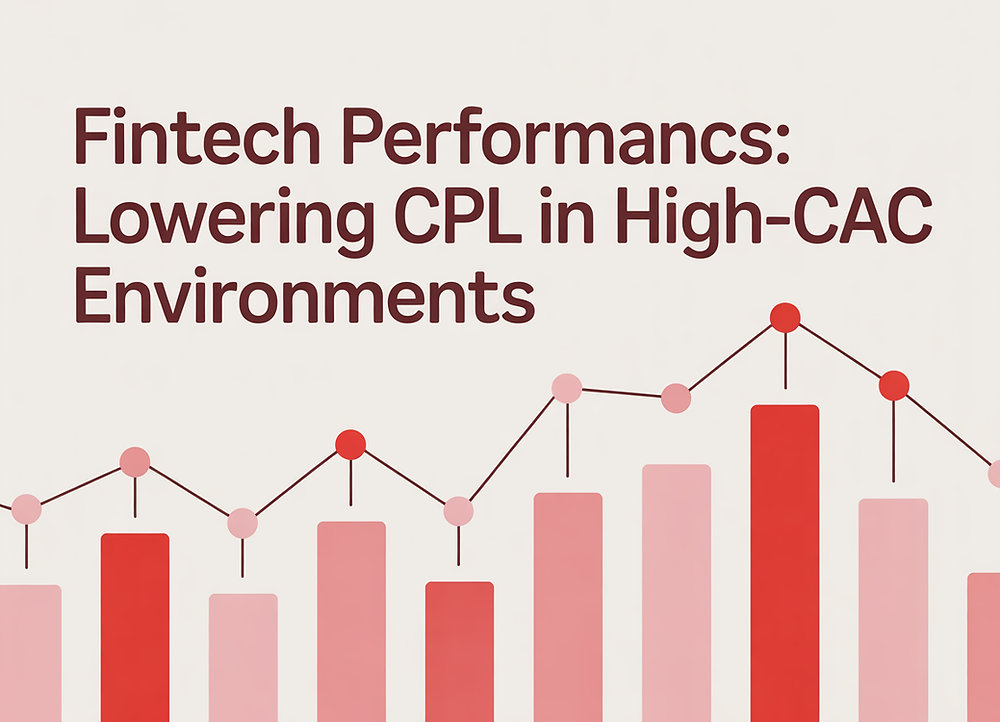
Fintech customer acquisition cost is on the rise every year. As regulatory complexity, competition, and fraud prevention increase the friction, average fintech CAC has risen to more than $200 in most verticals. The challenge: What do you do to lower CPL fintech without affecting quality and compliance?
The solution is strategic optimization throughout all the acquisition funnels. High CAC fintech strategies demand accuracy, experimentation, and awareness about your money.
Understanding Why Fintech CAC Runs High
Regulatory edicts cause discontinuity. KYC checks, identity checks, and compliance documentation add additional steps that drop-off and decrease conversion rates and raise the cost per acquisition. There is a high level of competition on high-intent keywords. Such terms as personal loan or investment app have high CPCs. Qualified traffic is desired by everyone.
Consideration cycles increase costs because they take time. Trust is needed when making financial decisions. Users shop around and drop, which needs remarketing expenditure. This is complicated with fraud prevention. Firms have to strike a balance between user experience and security, and overly aggressive filters may disallow users who are legitimate and a waste of money on ads.
Audit Your Current Funnel Economics
The best place to begin your fintech performance marketing would be to know your current numbers. Most firms emphasize the top-of-the-funnel measurements and ignore the point of value leakage.
Divide your actual costs of acquisition by segment. Not all leads are equal. Organic social lead is likely to have a lower CPL and a higher fraud rate. Leads through Google search are more expensive to buy but convert better. Break down your analysis by channel, type of creativity, and audience.
Identify drop-off points. Where do users abandon? Is it during KYC? After seeing fees? During account funding? Every drop-off point will be a chance to lower CPL fintech campaigns by removing a particular friction.
Measure time-to-value. Users who have an easy time finding their aha moment, whether it is finalizing their first transaction, investment growth, or loan approval, have a better LTV and warrant a higher acquisition cost.
Channel Optimization for Lower CPL

Different channels require different approaches to achieve lower CPL fintech goals.
- Paid Search Refinement: Use commercial intent long-tail keywords instead of spending money on competing against costly head terms. A small business loan for contractors is easier to convert and cheaper than a business loan. Use negative keywords with aggressiveness to filter out waste. Create different campaigns based on the intent of the users, research, and ready-to-apply.
- Meta and Social Advertising: Leverage lookalike audiences based on high-LTV customers, and not only converters. Test video content giving an explanation of your value proposition and requesting signups. Take the interest ahead of users through complicated applications by using the lead forms. Interest targeting is not an effective strategy in fintech; add behavior signals.
- Programmatic and Display: Retargeting is where display shines for fintech. Create custom audiences of those users who only began but never finished applications. Provide social evidence, solve counterarguments, and invoke a sense of urgency. Exclude converted users instantly to avoid impression wastage.
- Affiliate and Partnership Marketing: Performance partnerships with financial advisors, comparison sites, and content creators are becoming part of the portfolio of high CAC fintech strategies. Partnerships have to be managed overhead, but they tend to achieve lower CPL than paid channels since traffic is filtered by partners.
Fintech CPL Benchmarks by Channel in 2025 – What You Should Actually Be Paying
The average CPL for Google Ads across all industries currently comes in at $70.11, up 5.1% year-over-year from 2024’s $66.69. Financial services’ blended CPL for Google comes in at around $653, ranking second only to legal, which comes in at $761. When it comes to fintech, for growth-stage campaigns, CPLs come in at $60 to $150 for campaigns targeting the entire fintech space, but targeting CFOs and risk officers at an enterprise level comes in at much higher, above $200. Click-through rates for sponsored content come in at 0.4% to 0.6% for LinkedIn, with CPCs of $5 to $7, rising to $20+ for targeting precise executive-level segments.
For financial services, CPLs for lead-gen forms targeting the top of the funnel on Meta/Facebook come in at $35 to $75, which is cheaper than search and LinkedIn but has notably worse lead quality and higher fraud risk, thus requiring lead scoring to filter out MQLs from junk leads. When looking at fintech CPLs, blended across both organic and paid, this comes in at around $452. When looking at fintech CPLs organically, this comes in at $410.
Creative and Messaging That Converts
Your creative strategy dramatically impacts fintech performance marketing efficiency.
Lead with value, not features. "Get approved in 5 minutes" matters more than "AI-powered underwriting." The users are interested in results, faster access to capital, better returns, reduced fees, not in your technology stack.
Counter arguments upfront. In case of credit score requirement concerns, expect the users to state it beforehand. When fees are an issue with them, be open. Avoiding the need to ask questions to answer them helps to decrease friction and increase conversion rates.
Use authentic social proof. Fake testifying does not shift the needle. Specific outcomes do. "I got $50,000 for my bakery expansion in 24 hours" wins over “Great service!” Video testimonials by the actual users are more trust-building than written ones.
Progressive disclosure test. Gather information bit by bit instead of requesting everything. Begin with general information, demonstrate individual offers or rates, and ask to provide full documentation. This method reduces the initial CPL without a decrease in the quality of conversion.
Landing Page and UX Optimization
Your landing page can make or break fintech customer acquisition cost efficiency.
Reduce form fields ruthlessly. Removal of every field adds to conversion rates. Only enquire about what is necessary to qualify in the first place. Details could be gathered after committing users. Make KYC a continuation rather than a judgment. Present frame identity verification as a security of your account instead of a process. Show progress bars. Demonstrate the significance of every step.
Mobile optimization is non-negotiable. With 73% of fintech app sessions occurring via mobile devices globally, and users interacting with a paid ad prior to launching the app on their mobile device, it’s obvious what this means for CPLs. Single-click mobile lead forms can deliver 40% more completions than multi-step processes. This means that each additional field in your mobile-based customer KYC and application processes has a quantifiable cost in terms of leads.
Test your mobile optimization on actual devices, rather than just using responsive design previews. Compress images, defer non-critical scripts, and utilize lazy loading. Every additional second of load time increases mobile abandonment rates by around 20%, which has a direct impact on CPLs.
Leveraging First-Party Data
As third-party tracking erodes, first-party data becomes crucial for lower CPL fintech campaigns.
Create elaborate user profiles based on application data. Unfinished applications are also good clues, such as the level of income, type of business, and credit issues. Feed this information to improve targeting and message.
Design tailored audiences for every funnel stage. Individuals who saw pricing should not receive the same message as people who initiated applications. Target not only by demographics but also by behavior.
Apply conversion API tracking. Tracking on the browser lacks conversions, particularly in fintech, where the user may take hours or days to complete applications after clicking an advertisement. The full journey is captured by the server-side tracking.
Compliance-First Marketing
Compliance with regulations is not a choice, but it does not necessarily strain fintech performance marketing efficiency.
Compliance with the creative since the beginning. Checking and editing advertisements to ensure compliance is time and money-consuming. Train imaginative teams on disclosures, claims that are forbidden, and approvals.
Have compliant landing pages. The mandated disclosures, privacy statements, and terms should not be too bold, but they should not take over the experience. Expandable sections or tooltips are used to give the necessary information without frustrating the users.
Document everything. When regulators pose questions, detailed records of your marketing practices cover your company and avoid expensive time wastage.
Testing and Iteration
Successful high CAC fintech strategies are achieved by constant optimization.
Test one variable at a time. Simultaneously changing headlines, pictures, and call-to-actions makes it impossible to understand what was working. Systematic testing will provide valid data.
Allow tests to achieve significance. The time of conversion in fintech can take days or weeks. What appeared to be a promising test after 100 conversions may revert to form at a thousand.
Focus on micro-conversions. Trace click to price pages, use the calculator and frequently asked questions. These indicators forecast ultimate conversion and enable quick optimization cycles.
Conclusion
Lowering fintech customer acquisition cost in high-CAC environments requires a comprehensive approach. It is achieved through having a grasp of your funnel economics, using every channel strategically, developing a memorable creative, developing frictionless experiences, and using data smart.
The performance marketing victors among the fintech firms are not low spenders; they are smart spenders. They know their numbers, test relentlessly, and optimize for quality over volume. If you're struggling to achieve lower CPL fintech results while maintaining growth, it is possible to speed up the process by hiring an agency like Vicious Marketing, which is aware of the specifics of performance marketing and fintech issues.
FAQs
Q1. What is a good CAC for fintech companies?
The investor-grade LTV:CAC target for fintech is 4:1, meaning for every $1,450 spent acquiring a customer, that customer should generate at least $5,800 in lifetime revenue. A 3:1 ratio is the minimum sustainability floor, not the target. For CAC payback period, fintech B2C should recover acquisition costs within 12 months; B2B fintech within 18 months; enterprise fintech can sustain 24-month payback given higher contract values. Many fintech companies systematically understate their true CAC by 40–60% by excluding fraud screening costs, failed KYC processing, and sales team overhead. It means their actual LTV:CAC ratio is lower than dashboards report.
Q2. How long does it take to see results from CPL optimization?
Early gains can be observed in 2-4 weeks, although significant CPL costs will be achieved in 2-3 months of testing and optimization, since fintech has longer conversion times.
Q3. Should fintech companies prioritize CPL or customer quality?
Volume never prevails over quality. Having a low CPL does not matter when customers have high fraud rates, low LTV, and poor retention base.
Q4. Which channels typically deliver the lowest CPL for fintech?
Google and Bing search intent and strategic partnerships will tend to be better quality and lower CPL than social channels, but this depends on product and audience.
Q5. Can a digital marketing agency help reduce our fintech CAC?
Vicious Marketing specializes in fintech performance marketing, combining compliance expertise with advanced optimization strategies to lower CPL while maintaining quality and regulatory adherence.
Q6. What is the actual average CAC for a fintech company in 2025, and how does it compare to other industries?
Fintech takes the lead in terms of the cost to acquire a customer, reaching $1,450 per person, according to Phoenix Strategy Group’s 2025 benchmark. This is almost double the B2B SaaS sector, which comes in at $702; more than double the insurance sector, which comes in at $1,280; and many times higher than the e-commerce sector, which comes in at a mere $70. When considering enterprise financial services targeting institutional clients, the actual cost to acquire a customer can range between $2,167 and $4,056 per acquired customer.
Q7. How does KYC friction affect fintech CPL, and what can be done to reduce drop-off without compromising compliance?
KYC is the major chokepoint of any fintech onboarding process. It increases the cost of each lead as it increases the actual cost per lead substantially compared to the cost of each applicant. The solution to this is progressive disclosure. Only ask for what is needed to create a personalized offer or pre-approval signal at first and ask for all documents after users demonstrate commitment to completing an application. One-click mobile forms increase completions by 40% compared to multi-step forms.
Q8. Does organic content and SEO actually lower CPL in fintech, or is paid the only viable channel?
Organic channels always outperform paid channels in terms of cost per lead in the fintech space. According to fresh data for 2025, combined CPL for organic in the fintech space is around $410, while paid is around $490. This is a 16% difference before we even discuss how traffic grows over time. For financial services specifically, SEO leads generate MQL at 41% and SQL at 51%, significantly higher than 0.7% visitor-to-lead conversion for paid channels. There is a caveat: it takes 3-6 months for organic content to start delivering leads. The most effective way to acquire leads in the fintech space is through a combination of paid channels to deliver leads as quickly as possible and investing in organic content to drive CPL down over 12-24 months.